Top Features Every Plumbing & HVAC Website Needs in 2026
The majority of contractors' websites do not fail due to poor design. The reason behind their failure is that they lack the features that can convert visitors into calls.
By the end of 2026, it won’t be sufficient to only have a website. Your competitors already have one. The difference is whether your site is built to bring in work or just sit there. These are the features that count in case you are intending to have a new webpage or even considering a redesign.
1. Clear “Call Now” and Contact Buttons (Everywhere)

Image Source.
Once a person reaches your site, they need assistance.
A broken AC. No hot water. A leaking pipe.
They are not shopping around to have fun; they are seeking to make a phone call.
They are going to call off and get another contractor in case your phone number is not readily available.
What your site needs:
Click-to-call phone number at the top of every page
Sticky header with contact button
“Request Service” buttons throughout the page
Short, simple contact forms
Make it easy. No guessing. No hidden information.
2. Mobile-First Design (Not Just “Mobile-Friendly”)
Phones are bringing over 70% of your traffic.
When you have a bad or slow-loading site on mobile, you lose jobs, and that is as simple as it sounds.
In 2026, Google also ranks your site based on mobile performance first.
What to focus on:
Fast loading on mobile
Large, easy-to-click buttons
Simple layouts (no clutter)
Easy-to-read text
If it is annoying to browse through your site using a phone, nobody will stay.
3. Fast Load Speed
Speed is considered more than most contractors are aware of
When your website takes longer than a few seconds to load, people go to competitors.
And Google takes notice of that.
What slows sites down:
Huge images
Cheap hosting
Too many plugins
Poor coding
A quick site not only ranks better, but it also receives more calls.
4. Service Pages Built for SEO
It is no longer sufficient to have one page that has all your services.
In order to be ranked on Google, you should have one whole dedicated page per service.
For example:
AC Repair
Furnace Installation
Water Heater Repair
Drain Cleaning
Each page should clearly explain:
What you do
Where you service
Why someone should choose you
You are losing search traffic when you do not have pages dedicated to each service.
5. Local SEO Setup (So People Can Find You)

Image Source.
Your site must be designed in a way that it appears in the local searches, such as:
“Best HVAC repair in my area”
“plumbing and HVAC near me”
“plumber in [your city]”
“HVAC plumbing”
This comes down to proper local SEO setup.
Must-have elements:
City and service area pages
Google Business Profile integration
Consistent name, address, phone number (NAP)
Schema markup for local businesses
This is not possible otherwise; your site is virtually out there in your locality.
6. Real Reviews and Trust Signals
Individuals do not just choose a contractor that they come across.
They choose one that they can trust.
You should establish yourself as genuine within a few seconds on your site.
Add these:
Google reviews (embedded or displayed)
Before/after photos
Licenses and certifications
Years of experience
“Serving [City] for X years”
It is all about trust that makes a visitor make a call.
7. Simple, Straightforward Messaging
A majority of the plumbing and HVAC websites attempt to appear too professional.
That normally implies getting disoriented.
People do not want to see fancy words; they desire to have explicit answers.
Instead of:
“We provide comprehensive HVAC solutions…”
Say:
“We repair air conditioners quickly that make your house cool.”
Keep it simple. Convince as you would a customer over the phone.
8. Emergency Service Visibility
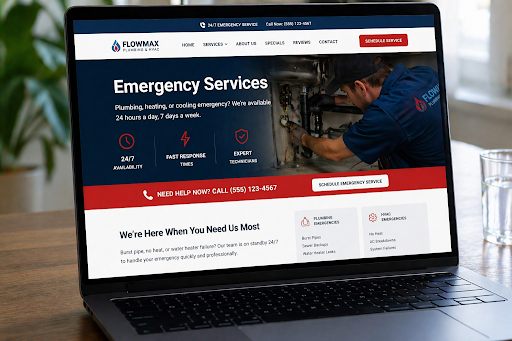
In case you provide emergency services, it should be apparent.
This is among the largest drivers of conversion.
What to include:
“24/7 Emergency Service” in header
Dedicated emergency service section
Fast contact options
People who search at 2 AM do not need to scroll, but they need assistance at that moment.
9. Strong Homepage Layout
Your home page must provide answers to three questions at first glance:
What do you do?
Where do you do it?
Why should I choose you?
A good layout includes:
Clear headline (“AC Repair in [City]”)
Quick list of services
Reviews/testimonials
Call-to-action buttons
Trust badges
In case a person is unable to grasp what your business is within 5 seconds, he or she is going to go away.
10. Location Pages for Service Areas
In case you have several cities to serve, you must have separate pages for each city.
Example:
AC Repair in Houston
Plumbing Services in Dallas
These pages help you show up in more local searches.
Each page should:
Be original (no duplication of content)
Talk of the city of its own.
Looking to have services that are unique to the area.
This is among the simplest means to increase traffic.
11. Easy Online Booking (Optional but Powerful)
The use of online booking instead of calling by homeowners is on the increase.
There is no need to substitute phone calls; however, it is a good idea to provide both.
Options:
Simple scheduling form
“Request Appointment” system
Quick quote forms
This has the ability to record leads in case you are busy or after working hours.
12. Ongoing SEO Content (Like Blogs)
A blog isn’t just for “looking active.”
It aids in ranking more keywords and generating constant traffic, especially when you focus on strategies like plumbing and HVAC seo to target the right audience.
Topics can include:
“Why is my AC not cooling?”
“Signs your water heater is failing”
“How often should you service your HVAC system?”
This creates credibility and exposure to more individuals.
Want to see the power of content? Take a look at our breakdown in our latest blog: Why 90% of Contractor Websites Fail to Turn Visitors Into Phone Calls.
13. Secure and Reliable Hosting
If your site goes down, you lose leads.
If it’s not secure, it hurts your rankings.
Basics you need:
SSL certificate (HTTPS)
Reliable hosting
Regular updates and backups
This isn’t flashy, but it matters.
14. Clear Call-to-Action on Every Page

Image Source.
Each page is to lead the visitor to action.
Never think that they will figure it out.
Use clear CTAs like:
“Call Now”
“Get a Free Estimate”
“Schedule Service Today”
And add them throughout the page, not only at the bottom.
15. Built to Convert (Not Just Look Good)
Many of the plumbing and HVAC websites appear good, but fail to perform.
The goal that should be facilitated by design is to receive calls and leads.
That means:
Clean layout
Easy navigation
Fast performance
Strong messaging
Clear next steps
Unless your site is attracting clients, then something is not right.
FAQs
1. How Much Does a Plumbing and HVAC Website Cost in 2026?
It is dependent on its construction. Custom contractor websites may be a little costly to design initially, though several companies now provide monthly plans. The main factor isn’t just price; it’s whether the site is built to rank on Google and generate leads.
2. How Long Does It Take to Build a Contractor Website?
The majority of plumbing and HVAC websites require 2-4 weeks to be created, depending on the number of pages and features you require. It can be even faster in case you already have your services and content ready.
3. Is SEO Really Important for Contractors?
Yes. The majority of house owners use Google in case they require plumbing or HVAC services. If your site is not appearing in the search engine, you are losing jobs.
4. Should I Include Online Booking on My Website?
It is not necessary, but it may be useful. Many customers would rather make reservations online as opposed to calling after hours. Having the two options provides additional opportunities to receive leads.
5. How Often Should I Update My Website?
It does not require frequent redesigning, but it must be updated. Posting new material, service updates, and improving SEO over time will help your site rank and remain competitive.
Final Thoughts
One thing that a contractor site ought to accomplish is to convert visitors into calls.
When your site is not generating leads regularly, it is not because the website does not work; it is just that the right sections are not in place.
The contractors winning right now aren’t just “having a website.” They have a to-the-point message, quick loading time, high levels of trust established, and a layout that makes people act. Get this right and your website shifts from a passive internet object into an active, 24/7 lead-generating engine for your business.
At Web Design Ventures, we help plumbing and HVAC businesses turn their websites into consistent sources of calls and qualified leads, not just something that looks good online. Our focus is on building fast, mobile-first websites that rank well, build trust quickly, and make it easy for customers to take action.
If you're unsure how your current website is performing, a free audit can reveal what’s working, what’s missing, and where opportunities exist to improve lead flow over time. Starting at $0 to $175/month (hosting included), our packages are easy to understand and available for everyone. You’ll receive a fully custom 5-page website, foundational SEO to ensure you get found, unlimited updates, and ongoing support, all the tools at your disposal to turn your website into a dependable source of new business.